Common HSP Application Mistakes and How to Avoid Them
The HSP visa has a reputation for being straightforward compared to other immigration pathways — calculate your points, gather your documents, submit. And in principle, that's true. But "straightforward" doesn't mean "hard to mess up." Immigration officers see the same mistakes over and over, and each one costs applicants weeks or months in delays.
This guide covers the errors that actually happen in practice — not theoretical edge cases, but the mistakes that trip up real applicants. Some are easily fixable. Others can force you to restart the entire process. A few are irreversible.
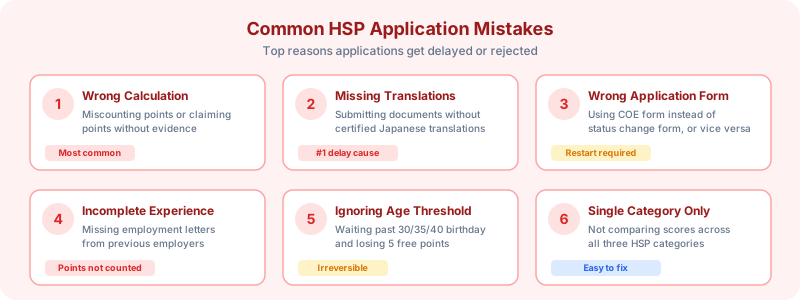
Mistake 1: Miscounting Your Points
This is the single most common error, and it takes several forms.
Claiming Points You Can't Prove
The HSP system is self-declared — you calculate your own points. But every point you claim needs documentary evidence. People regularly claim points for things like:
- Work experience they can't get employment letters for (because they've lost touch with previous employers)
- University ranking bonuses without checking whether their university actually qualifies
- Professional certifications that aren't on the recognized list
- Research papers that were internal company reports, not published academic papers
Immigration will ask for evidence. If you can't provide it, those points don't count — and if the remaining points fall below 70, your application is rejected.
How to avoid it: Before you submit, go through your points calculation line by line and ask yourself: "Can I produce a document that proves this?" If the answer is no for any line item, don't claim those points. Check the official calculation sheet for exactly what counts in each category.
Miscalculating Income Points
Income scoring in the HSP system has quirks that catch people off guard:
- It's annual income, not monthly salary × 12. Bonuses, overtime, and allowances count. But some allowances (like commuting allowance) may not.
- The thresholds change based on age. A 28-year-old and a 36-year-old with the same salary score very differently.
- It's pre-tax income from your current employment. Stock options, rental income, and other non-employment income typically don't count.
A common scenario: someone calculates their income based on their monthly salary, forgets that the HSP system uses annual income inclusive of bonuses, and ends up in a different income bracket than they expected.
How to avoid it: Use your latest withholding tax certificate (gensen choshuhyo / 源泉徴収票) as the definitive income figure. That's the number immigration will use to verify.
Not Running All Three Categories
Maybe the biggest missed opportunity rather than a "mistake" per se. The same person can score 62 under Category 2 and 75 under Category 1, or vice versa. The three HSP categories weight experience, income, research, and education differently.
Many people default to Category 2 (Technical/Specialist) because it's the most common work visa equivalent. But researchers might score better under Category 1 (Academic), and senior managers might score better under Category 3 (Business).
How to avoid it: Always run your numbers through all three categories using the official calculation sheet. Use the category where you score highest.
Mistake 2: Missing or Invalid Translations
This is the number one cause of application delays. Japan's immigration system requires all foreign-language documents to be submitted with Japanese translations.
What Needs Translation
Every document not originally in Japanese needs a certified Japanese translation:
- Degree certificates and academic transcripts
- Employment letters and contracts from non-Japanese companies
- Professional certifications
- Patent documents from foreign patent offices
- Recommendation letters
Translation Requirements
The translations must:
- Be complete (not summaries or excerpts)
- Include the translator's name, address, and signature
- State the translator's relationship to the document (professional translator, employer, etc.)
- Be dated
You can do translations yourself, but professional translations from certified translators are less likely to raise questions. Immigration doesn't require sworn translations by law, but a professional translation with the translation company's stamp carries more weight than your own translation.
The Most Common Translation Mistake
People submit their degree from a Chinese, Korean, Indian, or European university without any Japanese translation, assuming that because it's from a well-known university, immigration will understand it. They won't. The document goes into a pile of "additional documents required," and your processing time jumps by weeks.
How to avoid it: Get translations done before you submit. Build translation time into your preparation schedule — professional translations typically take 1-2 weeks.
Mistake 3: Using the Wrong Application Form
There are different forms for:
- Certificate of Eligibility (COE) — for people applying from outside Japan
- Change of Status of Residence — for people already in Japan on a different visa
- Extension of Period of Stay — for people already on HSP who need to renew
Using the COE form when you should use the Change of Status form (or vice versa) means starting over from scratch. Immigration won't convert one to the other — they'll return your application and ask you to resubmit with the correct form.
How to avoid it: Check the ISA website for the correct form. If you're already in Japan on a work visa and switching to HSP, you need the Change of Status form. If you're applying from outside Japan (or your employer is applying on your behalf), you need the COE form.
Mistake 4: Incomplete Work Experience Documentation
Work experience is a major points category, and documenting it properly is where many applications fall apart.
What Immigration Wants
For each period of employment you're claiming points for, immigration wants:
- An employment certificate (在職証明書) or reference letter from the employer
- The letter must state: your job title, employment dates, and a description of your duties
- It should be on company letterhead with an official stamp or authorized signature
The Problem
Getting these documents from previous employers — especially foreign companies — is often harder than people expect:
- Companies that have been acquired or gone out of business can't issue letters
- Former managers may have moved on and can't be reached
- Some companies have policies against providing detailed employment letters
- Foreign company letters often lack the specific format that Japanese immigration expects
If you can't document a period of employment, you can't claim points for it. Claiming 10 years of experience but only being able to document 6 means you only get points for 6.
How to avoid it: Start collecting employment certificates before you start the application process. Reach out to former employers early. If a company no longer exists, gather alternative evidence: old contracts, payslips, tax records, LinkedIn profiles, social insurance records from that country. Immigration has some discretion in accepting alternative documentation, but the primary request will always be for employer-issued letters.
Mistake 5: Ignoring Age Thresholds
The HSP points system awards age points on a declining scale:
| Age Range | Points |
|---|---|
| Under 30 | 15 |
| 30-34 | 10 |
| 35-39 | 5 |
| 40+ | 0 |
These are hard cutoffs at your birthday. If you're 29 years and 364 days old, you have 15 age points. The next day, you have 10.
Why This Matters
The damage from crossing an age threshold is irreversible and immediate. No amount of additional qualifications, salary increases, or certifications can undo the loss of age points. If you're sitting at exactly 70 points at age 29 and you turn 30 before applying, you drop to 65 — and you're no longer eligible.
More subtly, age thresholds affect your PR qualifying period. If you start the 1-year fast track at 79 points with age as a contributing factor, and you'll turn 35 during that year, your points drop to 74 — below the 80-point threshold — and you may need to shift to the 3-year path instead.
How to avoid it: Know your age-related point drop dates. If you're within 6-12 months of a threshold, treat it as urgent. Apply before your birthday, even if it means accelerating your preparation timeline. Every day you wait past a threshold is points permanently lost.
Mistake 6: Not Comparing All Three HSP Categories
This was mentioned under points miscounting, but it's important enough to call out separately. Immigration statistics suggest that a significant number of applicants who don't qualify under their chosen category would have qualified under a different one.
The three categories have fundamentally different scoring structures:
- Category 1 (Academic Research): Favors education and research output. Lower income thresholds. Best for PhDs, researchers, university staff.
- Category 2 (Technical/Specialist): Balanced scoring. Most common category. Best for engineers, IT professionals, specialists.
- Category 3 (Business Management): Favors income and business experience. Higher income thresholds but more points for management experience. Best for executives, senior managers.
A concrete example: a 33-year-old with a Master's degree, 8 years of experience, earning 6 million yen, with JLPT N2, might score:
- Category 1: 75 points (experience weighted more generously)
- Category 2: 70 points (standard weighting)
- Category 3: 68 points (income threshold is higher for equivalent points)
Under Category 2, this person barely qualifies. Under Category 1, they're comfortably above the threshold. Under Category 3, they don't qualify at all. Same person, same credentials — different outcomes.
How to avoid it: Use the official calculation sheet and calculate your score under all three categories. Apply under the one where you score highest. If you're close to 80 points in one category but only at 70 in another, the category choice could mean the difference between 1-year and 3-year PR eligibility.
Mistake 7: Salary-Related Documentation Errors
Using the Wrong Income Figure
People commonly use:
- Their monthly salary × 12 (missing bonuses)
- Their gross income including non-employment income
- Their net/take-home pay instead of pre-tax
- An offer letter salary that's different from their actual withholding certificate
The authoritative document is your withholding tax certificate (源泉徴収票). Use that number.
Not Accounting for Salary Changes
If your salary changed during the qualifying period for PR, you need to be able to show that your total points — including the income component — stayed above the threshold at every point. A job change that temporarily reduced your salary, even for a month, could be flagged.
How to avoid it: Keep copies of every withholding tax certificate. If you're in your PR qualifying period, understand that any salary reduction could affect your total points.
Mistake 8: Timing and Process Errors
Applying Too Late After Entering Japan
If you're applying for a Change of Status to HSP, there's no hard deadline — but there are practical considerations. The longer you wait, the more likely your circumstances change (age increases, salary fluctuations, etc.). Also, time spent on a non-HSP visa doesn't automatically count toward your PR qualifying period unless you can retroactively prove your points.
Not Keeping Records During the Qualifying Period
For PR applications, you'll need to demonstrate that your points were at or above the threshold for the entire qualifying period. People who don't keep records struggle to reconstruct this evidence years later.
How to avoid it: Start a simple file — physical or digital — where you keep copies of:
- Annual withholding tax certificates
- Employment contracts and any amendments
- Points calculations at each year-end
- Records of any changes that affect your score (new certifications, salary changes, etc.)
Missing the Re-entry Permit
If you leave Japan for more than 1 year without a re-entry permit (or 2 years with a special re-entry permit), your residence status is revoked — and your HSP qualifying period resets. This catches people during extended overseas assignments or family emergencies.
How to avoid it: Always get a re-entry permit before leaving Japan for an extended period. It's a simple process at the immigration bureau.
Mistake 9: Employer-Related Oversights
Not Claiming the SME/Innovation Bonus
If your employer is a small-to-medium enterprise receiving government support, or a company participating in innovation promotion programs, you may be eligible for bonus points (+10). Many employees don't know about their employer's status because companies don't advertise it.
How to avoid it: Ask your company's HR or legal department whether the company is designated under any government innovation or SME support programs relevant to HSP. This is free points that require no effort on your part beyond asking.
Employer Cooperation Issues
Your employer needs to provide certain documents: company registration, financial statements, your employment contract, and sometimes a letter confirming your role and duties. Some employers — especially smaller companies unfamiliar with the HSP system — are slow to provide these.
How to avoid it: Brief your HR department early. Explain what documents you'll need and give them time to prepare. If they're unfamiliar with HSP, point them to the ISA's HSP information page.
A Pre-Submission Checklist
Before you submit your HSP application, run through this:
- Calculated points under all three categories
- Every claimed point has documentary evidence ready
- All foreign-language documents have Japanese translations
- Using the correct application form (COE vs. Change of Status vs. Extension)
- Income figure matches withholding tax certificate
- Employment letters obtained from all previous employers being claimed
- University checked against ranking lists if claiming ranking bonus
- Photo meets specifications (4cm × 3cm, recent)
- All forms filled out completely — no blank fields
- Copies made of everything being submitted
The Bigger Picture
Most HSP application mistakes share a common root cause: rushing. People calculate their points, get excited that they qualify, and submit without thoroughly checking every detail. The extra week spent double-checking documents, getting translations done, and verifying every claimed point is a week that can save you months of delays.
If you're not sure about your score, use the official calculation sheet to verify. If you need help boosting your points, check our guide on improvement strategies. And when you're ready to start the process, review the application process guide for a step-by-step walkthrough.
Take your time with the preparation. Get it right the first time. The HSP system rewards careful, well-documented applications — and penalizes careless ones.