How to Increase Your HSP Points: Practical Strategies That Work
Here's the thing about the HSP points threshold: most people who don't qualify are a lot closer than they think. The gap between 65 and 70 points is usually just one thing they haven't considered — a university ranking bonus they didn't know existed, a JLPT test they could sit for, or simply running the numbers under a different category. Sometimes it's literally one checkbox on the official calculation sheet that they skipped over.
This guide covers every practical way to bridge that gap — from things you can claim right now to strategies that take a year or more. Whether you're 5 points short or 20, there's a path forward.
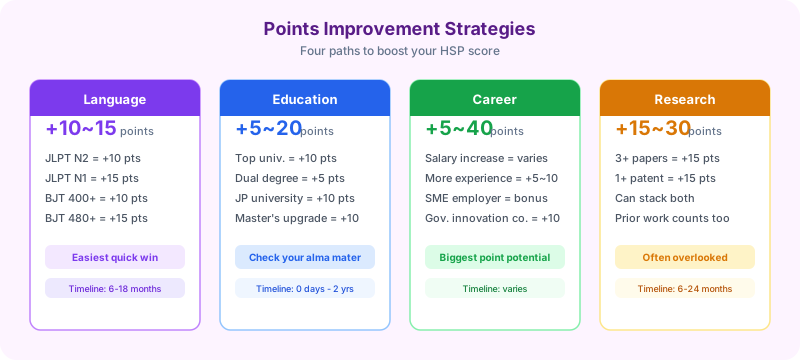
Quick Wins: Points You Might Already Have
Before you start planning for future improvements, check if you're already sitting on unclaimed points. This is surprisingly common — people leave 5 to 20 points on the table simply because they didn't know certain bonuses existed.
University Ranking Bonus (+10 pts)
This is the one most people miss. If your university appears in the top 300 of at least two out of three major global rankings — QS World Rankings, THE Rankings, or ARWU/Shanghai Rankings — you get 10 points.
You should also check the ISA's designated university list directly, because some universities qualify through government partner programs even if they're not in the global top 300.
If you went to any well-known university — we're talking places like UC Berkeley, University of Toronto, TU Munich, NUS, IITs, Tsinghua, Seoul National, etc. — there's a very good chance you qualify. Go check. Right now.
Dual Degree Bonus (+5 pts)
Have a Master's and an MBA? Or a Master's in Computer Science and another in Applied Mathematics? If you hold two different types of graduate degrees, that's an extra 5 points on top of your education score.
This also applies if you have a professional degree (like a JD or CPA qualification) in addition to an academic Master's or PhD. Many people have these qualifications from earlier in their career and forget to claim them.
Category Switching
This one is huge. The same person — same education, same salary, same everything — can score very differently under Category 1 (Academic Research), Category 2 (Technical/Specialist), and Category 3 (Business Management). The income thresholds differ, experience is weighted differently, and certain bonuses only apply to specific categories.
Always run your numbers through all three categories using the official points calculation sheet. You might discover you qualify under a category you never considered. More on this below.
Existing Patents or Research Papers
Think back through your career. Did you co-author academic papers during grad school or at a previous job? Were you listed as an inventor on any patents? Even one published patent gives you +15 points, and three or more research papers give you another +15.
These don't have to be from your current role. Published is published — it doesn't expire.
Short-Term Strategies (1-6 Months)
If you need to actively earn more points, these are the moves that give you the best return in the shortest time.
JLPT N2: The Single Highest-ROI Move (+10 pts)
For most people sitting below 70 points, passing JLPT N2 is the fastest way to close the gap. It's worth 10 points, and the test is held twice a year — July and December.
Here's what makes this so effective: JLPT is a written, multiple-choice exam. You don't need to speak Japanese fluently. You don't even need to write it. You need to read it and understand grammar patterns well enough to pick the right answer. Plenty of engineers who work entirely in English at their companies have passed N2 through focused study.
What does N2 require? Roughly speaking, you need to be able to read newspaper articles on general topics, follow conversations at near-natural speed, and understand around 6,000 vocabulary words and 1,000 kanji. It's not trivial, but with 3-6 months of dedicated study (or 6-12 months of more casual study), it's very achievable for someone who already lives in Japan.
Register on the JLPT official site well before the test date — registration fills up fast at popular testing locations.
BJT Business Japanese as an Alternative (+10 pts)
If the twice-a-year JLPT schedule doesn't work for you, consider the BJT Business Japanese Test. A score of 400+ gives you the same 10 points as JLPT N2, and the BJT is offered year-round at computer-based test centers. It focuses more on business scenarios — reading emails, understanding presentations, interpreting charts — which may feel more natural if you use Japanese at work.
Professional Certifications
Industry-specific qualifications recognized by Japan can count toward your HSP score. IT certifications (like those designated by Japan's IPA), accounting qualifications, and other professional licenses can add points. The exact value depends on your category and the specific certification, so check the ISA's HSP page for current details.
Medium-Term Strategies (6-18 Months)
These take more effort, but each one can make a major difference to your score.
JLPT N1: The Upgrade (+5 more pts over N2)
If you already have N2 and need more points, pushing to JLPT N1 adds another 5 points (bringing your Japanese language bonus from 10 to 15). N1 is significantly harder — it requires understanding nuanced, abstract text and near-native listening comprehension — but if you're already at N2 and living in Japan, it's a realistic 6-12 month goal.
Salary Negotiation and Job Switching
Income is the single largest scoring category in the HSP system, and the thresholds interact with age in ways that can swing your score dramatically. Look at this:
| Salary Move | Age Under 30 | Age 30-34 | Age 35-39 |
|---|---|---|---|
| From below 3M to 3M+ | +10 pts | +0 pts | +0 pts |
| From 4M to 5M | +5 pts | +5 pts | +15 pts |
| From 5M to 6M | +10 pts | +10 pts | +5 pts |
| From 7M to 8M | +5 pts | +5 pts | +5 pts |
A jump from 4M to 5M is worth a staggering 15 points for someone aged 35-39. That single raise could be the difference between qualifying and not.
If your current employer won't budge on salary, job switching is a legitimate strategy. Japan's tech market is competitive right now, and changing companies frequently results in a 10-20% salary bump. Just make sure the new role still qualifies under your intended HSP category.
Publishing Research Papers (+15 pts for 3+ papers)
Three or more papers in peer-reviewed journals or academic conferences earn you 15 bonus points. This sounds daunting, but consider:
- Conference papers count, not just journal articles
- Co-authored papers count — you don't need to be first author
- There's no requirement that papers be published while in Japan
- Industry publications at recognized conferences (like IEEE, ACM, etc.) qualify
If you're in a research-adjacent role, talk to your employer about co-authoring with university partners or publishing internal research. Some companies actively support this.
Filing Patents (+15 pts for 1+ patent)
Being listed as an inventor on one or more patents earns you 15 points. This includes:
- Patents granted in any country
- Even patent applications that have been published (not just granted)
- Co-inventorship counts — you don't need to be the sole inventor
If your company has a patent program, get involved. Many tech companies actively encourage employees to file invention disclosures, and the process from disclosure to published application can take 12-18 months.
Long-Term Strategies (1-2+ Years)
These require more commitment, but they're powerful moves if you're planning your career trajectory with HSP qualification in mind.
Getting a Master's Degree (+10 pts over Bachelor's)
If you have a Bachelor's degree (10 pts) and upgrade to a Master's (20 pts), that's a net gain of 10 points. Even better: if you earn that Master's from a Japanese university, you pick up an additional 10 points for the "Japanese university graduate" bonus — potentially a 20-point swing from a single decision.
Japan has excellent English-language Master's programs at universities like the University of Tokyo, Kyoto University, and Osaka University. Many are two years, and some employers will sponsor or support the tuition.
JICA Training Programs (+5 pts)
Completing certain training programs run by JICA (Japan International Cooperation Agency) or similar organizations earns you 5 bonus points. These programs are specifically designed for international professionals and cover a range of fields. Check JICA's current offerings if you want this bonus.
Government Innovation Company Bonus (+10 pts)
If your employer participates in government-backed innovation or R&D support programs, you get 10 extra points. You can't directly control this one, but you can factor it into job decisions. Companies that receive subsidies from programs like NEDO grants or METI innovation partnerships typically qualify. Ask your company's HR or legal team if you're unsure — they may already be on the list without advertising it.
Strategic Approaches
Beyond individual point items, there are meta-strategies that can make or break your application.
Timing Your Application
Age thresholds in the HSP system are hard cutoffs, and they can cost you 5 points overnight:
- Turning 30? Apply before your birthday. You drop from 15 to 10 age points.
- Turning 35? Same thing. You drop from 10 to 5.
- Turning 40? You lose your last 5 age points entirely.
If you're within 6 months of an age threshold and close to qualifying, prioritize getting your application in before the birthday. This is one of the most common "if only I'd known" regrets.
Category Switching: A Deeper Look
The three HSP categories are designed for different professional profiles, but there's more overlap than you'd think:
| Factor | Cat 1 (Academic) | Cat 2 (Technical) | Cat 3 (Business) |
|---|---|---|---|
| Best for | Researchers, professors | Engineers, IT specialists | Managers, executives |
| Experience weighting | Most generous | Standard | Standard |
| Income thresholds | Lower requirements | Standard | Higher thresholds |
| Research papers | Highest value | Count as bonus | Less relevant |
| Business track record | Less relevant | Less relevant | Highest value |
Here's a real example: a software engineer with a PhD, 8 years of experience, and a modest salary might score 68 under Category 2 (Technical) but 78 under Category 1 (Academic Research), because Category 1 gives more weight to experience and values the PhD more highly.
The official ISA HSP page has complete scoring tables for all three categories. Run your numbers through each one.
The "70 vs 80" Decision
Two thresholds matter in the HSP system:
- 70 points = HSP status (permanent residency eligible after 3 years)
- 80 points = Fast-track (permanent residency eligible after just 1 year)
If you're sitting at 72-75 points, it's genuinely worth strategizing to reach 80. The difference between waiting 3 years and 1 year for PR is enormous — especially for people whose life plans (buying property, bringing family, career freedom) depend on permanent residency.
The 5-10 extra points to bridge from 75 to 80 might come from a JLPT certification, a salary bump, or claiming a bonus you hadn't considered.
Real Improvement Scenarios
Theory is nice, but let's look at how real people close the gap.
Case A: Engineer Goes from 63 to 83
Starting position (63 pts):
- Age 28 (15 pts), Bachelor's from a well-known university (10 pts), 4 years experience (5 pts), earning 5M (15 pts), no JLPT, no bonuses claimed
- Total: 15 + 10 + 5 + 15 + 0 = 45 pts... wait, that's only 45. Let's say Master's degree (20 pts): 15 + 20 + 5 + 15 = 55 pts. Plus 8 years experience (15 pts): 63 pts
What they did:
- Checked university against rankings — it was in the top 300 of QS and THE: +10 pts
- Passed JLPT N2 after 4 months of study: +10 pts
New total: 83 pts — qualified for the 1-year PR fast track. Two moves. That's it.
Case B: Researcher Switches Category, 68 to 76
Starting position under Category 2 (68 pts):
- Age 34 (10 pts), PhD (30 pts), 5 years experience (10 pts), earning 5M (15 pts), 4 published papers (not enough focus on Cat 2 scoring)
- Kept hitting a wall because Category 2 doesn't weight research experience as heavily
What they did:
- Recalculated under Category 1 (Academic Research) — experience jumped from 10 to 15 pts, and research papers now counted for full bonus: +8 pts net gain
New total: 76 pts under Category 1. No new certifications needed. No salary change. Just picked the right category.
Case C: Manager Pushes from 72 to 82
Starting position (72 pts):
- Age 36 (5 pts), Master's (20 pts), 10 years experience (20 pts), earning 7M (25 pts), JLPT N2 (10 pts), no other bonuses
- Had an MBA in addition to the Master's but hadn't claimed it
What they did:
- Claimed dual degree bonus (Master's + MBA): +5 pts
- Negotiated salary from 7M to 8M at annual review: +5 pts
New total: 82 pts — crossed the 80-point threshold for 1-year PR eligibility.
What NOT to Do
A few common mistakes people make when trying to boost their points:
-
Don't fabricate or exaggerate experience. Immigration does verify employment history. Getting caught means not just rejection but potential bans.
-
Don't assume you need a higher degree for everything. If you're a Bachelor's holder at 65 points, spending two years on a Master's (+10 pts) might make sense — but passing JLPT N2 (+10 pts) in 4 months gets you there faster.
-
Don't ignore the age clock. If you're 29 and planning to "apply next year," you're about to lose 5 free points. Think about whether it's worth waiting.
-
Don't forget to check all three categories. Many people apply under Category 2 (Technical) by default without realizing they'd score higher under Category 1 or 3.
-
Don't overlook your employer's status. Companies with government innovation support give you +10 points. If you're job hunting and choosing between two offers, this could be the tiebreaker.
-
Don't count on points you can't document. Every point needs supporting evidence — diplomas, certificates, tax records, patent filings. If you can't prove it, you can't claim it.
Your Next Step
Calculate your current score across all three HSP categories using the official ISA calculation sheet. Write down where you stand, identify the gap, and then come back to this guide to find the most efficient path to close it.
Most people discover they're closer than they thought. The question isn't usually "can I qualify?" — it's "which combination of moves gets me there fastest?"
Check the ISA's HSP overview page for the latest official guidelines, and start planning your path forward.