How to Apply for Japan's HSP Visa: Step-by-Step Process
The most stressful part of the HSP visa process isn't calculating your points — it's figuring out the actual application logistics. Which office do you go to? What documents do you need? How long does it really take? The official government guidance is... functional, let's say, but it leaves a lot of practical questions unanswered.
This guide walks you through the entire process from start to finish, with the kind of detail that actually helps.
The Application Process at a Glance
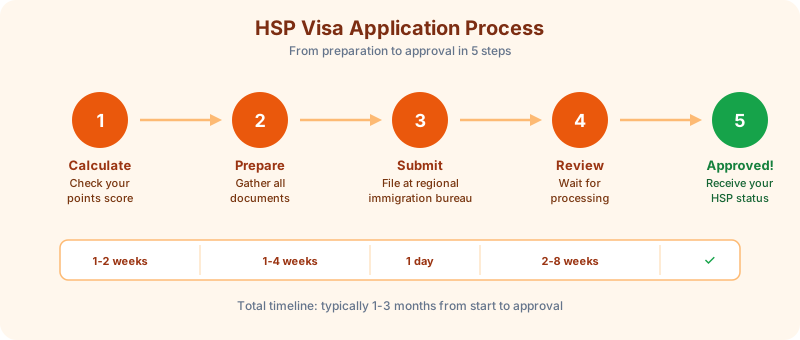
The whole process typically takes 1 to 3 months from start to approval. Let's break down each step.
Step 1: Calculate Your Points (and Double-Check)
Before anything else, you need to know your score — and which of the three HSP categories gives you the best one.
What to do:
- Use our points calculator or the official Immigration Services Agency worksheet
- Calculate your score under all three categories (Academic, Technical, Business)
- Pick the category with the highest score
Critical details:
- You can only apply under one category. Choose the one where you score highest.
- If you're between 68-72 points, double-check every bonus category. Many people miss university ranking points, JLPT credits, or dual-degree bonuses.
- Your points are evaluated as of your application date, not your arrival date. If you're turning 30 next month and that costs you 5 age points, apply now.
Common pitfall: People rush this step. Take time to verify each claim you're making — immigration will ask for evidence for every single point. If you claim JLPT N2, you need the certificate. If you claim 7 years of experience, you need documentation from each employer.
Step 2: Gather Your Documents
This is usually the most time-consuming step, especially if some documents need to come from overseas. Start early.
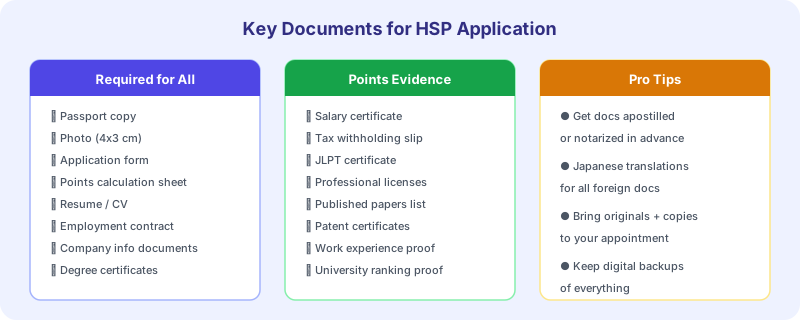
Documents Everyone Needs
- Passport — Valid for the duration of your intended stay
- Photograph — 4cm x 3cm, taken within the last 3 months, white background
- Application form — The specific form depends on whether you're applying from inside or outside Japan (more on this below)
- Points Calculation Sheet — The official form where you list your claimed points with evidence references
- Resume / CV — Covering your complete work history
- Employment contract or offer letter — Must show your position, salary, and employment period in Japan
- Company information — Your employer's registration certificate (登記事項証明書), annual report, or business overview
- Degree certificates — Original or certified copies of all degrees you're claiming points for
Documents for Points Claims
For every point you claim, you need supporting evidence:
- Salary: Employment contract showing annual compensation, most recent payslip, or tax withholding slip (源泉徴収票)
- Work experience: Employment certificates from each employer stating your position, duties, and dates
- Japanese language: JLPT score certificate or BJT results
- Research papers: List of publications with journal names and dates
- Patents: Patent certificates or published patent applications
- University ranking: Your degree certificate (the ranking is verified by immigration)
- Professional licenses: Copies of your certifications
Pro Tips for Documents
- Get translations done early. All non-Japanese documents need certified Japanese translations. This alone can take 1-2 weeks.
- Apostille or notarize foreign documents. Some countries require apostille certification for documents to be recognized internationally. Check your country's requirements.
- Bring originals AND copies. Immigration will want to see originals but keep copies. Bring both to avoid a second trip.
- Keep digital backups. Scan everything. If a document goes missing, you'll need to resubmit, and having a digital copy speeds up replacements.
Step 3: Determine Your Application Path
There are two different procedures depending on your current situation:
Path A: Applying from Outside Japan (Certificate of Eligibility)
If you're outside Japan and want to come in on an HSP visa, your sponsoring company in Japan files for a Certificate of Eligibility (COE) on your behalf.
Process:
- Your employer submits the application at their nearest Regional Immigration Services Bureau
- Processing takes approximately 2-8 weeks (HSP applications are prioritized)
- Once approved, the COE is mailed to your employer
- Your employer sends you the COE
- You take the COE to your nearest Japanese embassy/consulate to get the visa stamped in your passport
- Enter Japan within 3 months of the COE issuance date
Important: The COE has a validity period. If you don't enter Japan within 3 months, it expires and you need to start over.
Path B: Applying from Inside Japan (Change of Status)
If you're already in Japan on a different visa (work visa, student visa, etc.), you apply for a Change of Status of Residence at your local Regional Immigration Services Bureau.
Process:
- You personally visit the immigration bureau (or your employer's immigration lawyer/行政書士 goes on your behalf)
- Submit all documents at the counter
- Processing takes approximately 2-4 weeks for HSP changes (faster than new COEs)
- Return to pick up your new residence card when notified
Important: While your change-of-status application is being processed, your current visa status remains valid. You can continue working normally.
Which Regional Immigration Bureau?
You submit your application at the bureau that has jurisdiction over your address (or your employer's address for COE applications). The major ones:
- Tokyo: Shinagawa Immigration Bureau (品川) — the busiest one, expect long waits
- Osaka: Osaka Regional Immigration Bureau (大阪)
- Nagoya: Nagoya Regional Immigration Bureau (名古屋)
- Fukuoka: Fukuoka Regional Immigration Bureau (福岡)
Pro tip: Go early. Shinagawa can have 2-3 hour waits during peak times (typically Monday mornings and days right after holidays). Some bureaus now offer appointment systems — check the ISA website.
Step 4: The Review Process
After submission, your application enters the review queue. Here's what happens behind the scenes:
What immigration checks:
- Verification of all claimed points against submitted evidence
- Background check
- Company sponsorship legitimacy
- Salary and employment terms compliance
Timeline expectations:
- HSP applications get priority processing. This is one of the perks of the HSP category — the government wants to process these quickly.
- COE (from outside Japan): Typically 2-8 weeks, but can stretch during busy periods
- Change of Status (from inside Japan): Usually 2-4 weeks
- If additional documents are requested: Add 1-2 weeks per request
What can slow things down:
- Missing or incomplete documents (the #1 reason for delays)
- Application submitted during peak periods (April and October, when fiscal year and semester changes trigger waves of applications)
- Employer documentation issues (small companies or startups sometimes lack standard corporate documents)
Can you check status? Yes — you can call or visit the immigration bureau to ask about your application status. Have your application receipt number ready.
Step 5: Approval and Next Steps
When your application is approved:
If you applied for a COE (from outside):
- Your employer receives the COE by mail
- They send it to you
- Take the COE + passport + visa application form to your nearest Japanese embassy/consulate
- The embassy issues your visa (usually within a few days)
- Enter Japan — your residence card will say "Highly Skilled Professional"
If you applied for Change of Status (from inside):
- You receive a postcard notification (はがき) at your registered address
- Visit the immigration bureau with the postcard, your passport, your old residence card, and a ¥4,000 revenue stamp (収入印紙)
- Receive your new residence card with "Highly Skilled Professional" status
After Getting HSP Status
Congratulations — but there are a few things to keep in mind:
Your 5-year clock starts ticking. HSP grants a 5-year period of stay. Mark your calendar for renewal (though many people transition to permanent residency before then).
Start tracking your PR eligibility. If you scored 80+ points, you're eligible to apply for permanent residency after just 1 year. If you scored 70-79, it's 3 years. Keep your documents in order — the PR application will require proof that you've maintained your points throughout.
Report changes. If you change employers, you need to notify immigration within 14 days. A job change doesn't automatically void your HSP status, but your new position and salary must still qualify.
Your spouse benefits immediately. Your spouse receives unrestricted work authorization. They can apply for this at immigration with your HSP residence card as evidence.
Common Application Mistakes
Based on real cases, here are the mistakes that trip people up most often:
-
Submitting without translations. Every non-Japanese document needs a certified Japanese translation. Submitting untranslated documents means an automatic "additional documents required" notice — adding weeks to your timeline.
-
Points calculation errors. Claiming points you can't evidence, or miscounting experience years. Immigration will verify everything.
-
Wrong application form. The forms for COE vs. Change of Status are different. Using the wrong one means starting over.
-
Letting the COE expire. You have 3 months from COE issuance to enter Japan. Don't miss this window.
-
Not bringing originals. Copies aren't sufficient. Immigration needs to see original degrees, certificates, and employment documents.
-
Ignoring the ¥3M income floor. If your Japanese salary is below ¥3M annually, you get zero income points — regardless of other compensation like stock options or overseas income.
Timeline Summary
| Phase | Duration | Notes |
|---|---|---|
| Points calculation | 1-2 days | Calculate under all 3 categories |
| Document gathering | 1-4 weeks | Translations and apostilles take time |
| Application submission | 1 day | Go early to avoid long waits |
| Immigration review | 2-8 weeks | HSP gets priority processing |
| Visa issuance (if from outside) | 3-5 days | At your local Japanese embassy |
Total: approximately 1-3 months from first calculation to HSP status in hand.
Ready to Start?
The first step is knowing your score. Use our free evaluation tool to calculate your HSP points across all three categories — it takes just a few minutes and shows you exactly where you stand.
Once you know your score, you'll have a clear picture of whether to apply now or which areas to strengthen first.