HSP Visa Document Checklist: Every Paper You Actually Need
Documents are where HSP applications go to die. Seriously. The points calculation is the fun part — you punch in numbers, see your score, feel good about yourself. But paperwork? That's where things actually break down. One missing translation, one unstamped certificate, one form that should have been a different form, and you're looking at weeks of delays while immigration sends you a polite letter asking you to try again.
This guide is a practical checklist of everything you need, organized the way you'll actually prepare it — not the way a government website would list it. Print it out, tape it to your wall, and check things off as you go.
Document Categories at a Glance
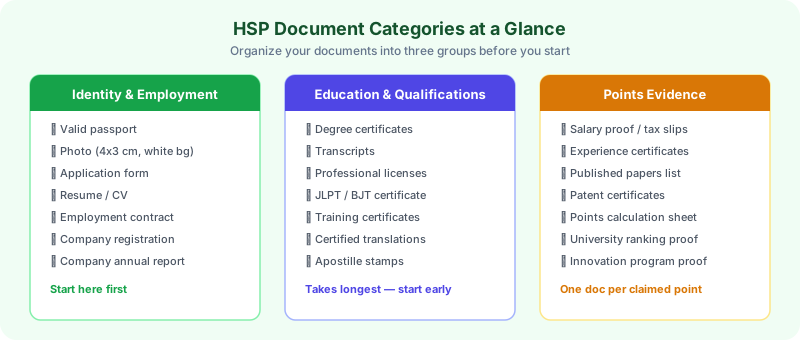
Your HSP application documents fall into three buckets: the universal stack that everyone submits, the evidence specific to whatever points you're claiming, and the translations and certifications that tie it all together. Let's work through each one.
The Universal Stack (Everyone Needs These)
No matter which HSP category you're applying under, no matter your background, you need all of the following. No exceptions.
| Document | Details | Where to Get It |
|---|---|---|
| Passport | Valid for the duration of your intended stay. Make sure you have blank pages. | Your country's passport office |
| Photograph | 4cm x 3cm, taken within the last 3 months, white background, no glasses | Any photo studio in Japan or your home country |
| Application Form | Different forms for COE vs. Change of Status — use the right one | ISA forms page |
| Points Calculation Sheet | The official form where you list every point you're claiming | ISA points calculation sheet (PDF) |
| Resume / CV | Complete work history with dates, job titles, and responsibilities | You write this yourself |
| Employment Contract | Must show position, salary, employment period, and work location in Japan | Your employer provides this |
| Company Documents | Employer's registration certificate (登記事項証明書), annual report, or business overview | Your employer provides this |
| Degree Certificates | Original or certified copies of all degrees you're claiming points for | Your university's registrar office |
A critical note on the application form: The specific form you need depends on whether you're applying for a Certificate of Eligibility (COE) from outside Japan, or a Change of Status from inside Japan. They are different forms. Using the wrong one is an automatic restart. Download the correct version from the ISA's materials page and double-check before filling it out.
Documents by Points Category
Here's where it gets personal. For every single point you claim on the points calculation sheet, you need to back it up with documentation. No evidence, no points. Immigration doesn't take your word for anything.
Income
Your annual salary is probably your biggest point-earner, so get this right.
- Employment contract showing your annual gross compensation in Japan (including bonuses and allowances)
- Recent payslips — the last 2-3 months is ideal
- Tax withholding slip (源泉徴収票) if you've already been working in Japan
Remember: immigration counts your Japanese gross salary only. Stock options, overseas income, and side gigs generally don't count. If your contract says ¥8M but your base salary is ¥6M with ¥2M in RSUs, clarify which portion immigration will actually recognize.
Work Experience
You need separate documentation from each employer in your career history. Not just your current one — every employer that contributes to the experience years you're claiming.
- Employment certificates from each company, stating your job title, responsibilities, and exact employment dates (start and end)
- If a former employer no longer exists, social insurance records or tax documents showing employment periods can sometimes substitute
This is the document that takes the longest to collect, especially if you've worked in multiple countries. Start requesting these certificates the moment you decide to apply.
Japanese Language Proficiency
- JLPT certificate — N1 gets you 15 points, N2 gets you 10 points
- BJT Business Japanese Test results — 480+ for 15 points, 400+ for 10 points
You need the actual certificate or score report, not a screenshot of your online results. If you passed JLPT years ago and lost the certificate, contact the JLPT organization about reissuance — it takes a few weeks.
Research Achievements
If you're claiming points for published research:
- A list of your published papers with journal names, publication dates, co-authors, and DOIs or URLs
- Copies of the actual publications (first page or abstract page is usually sufficient)
- For conference papers, the conference proceedings or acceptance letters
You need at least 3 published papers to claim these points. Immigration doesn't have a strict definition of what counts as a "research paper," but peer-reviewed journal articles and major conference proceedings are safe bets.
Patents
- Patent certificates for granted patents
- Published patent applications for pending patents (you don't need the patent to be granted)
- Documentation showing you're listed as an inventor
Both Japanese and international patents count. If your employer holds the patent but you're the named inventor, that works too.
University Ranking
Your degree certificate is the primary document here. Immigration verifies your university against the ISA's designated university list, which is based on appearances in at least two of the three major global rankings:
- QS World University Rankings (top 300)
- Times Higher Education World University Rankings (top 300)
- Academic Ranking of World Universities (ARWU/Shanghai) (top 300)
Check the ISA's official designated university list (PDF) to see if your alma mater is on it. If your university appears on at least two of the three rankings above, it almost certainly qualifies — but verify against the official list to be safe.
Professional Licenses and Certifications
- Copies of your professional certifications (IT certifications, engineering licenses, medical qualifications, etc.)
- These must be relevant to the HSP category you're applying under
Not all certifications count equally. National-level professional licenses (like Japan's Information Technology Engineer Examination) carry the most weight.
Translation and Certification Requirements
This is the step that trips up more people than any other. The rule is simple but absolute: all non-Japanese documents must be accompanied by certified Japanese translations.
Not Google Translate. Not your friend who speaks Japanese. A certified translation by a professional translator or translation agency, with the translator's name, address, and seal or signature.
What needs translating:
- Degree certificates
- Employment certificates from overseas employers
- Professional licenses issued outside Japan
- Any other supporting document not originally in Japanese
Timeline: Budget 1-2 weeks for professional translation services. If you have a lot of documents, it could stretch longer. Rush services exist but cost more.
Apostille — do you need one? If your documents come from a country that's a member of the Hague Apostille Convention, you may need an apostille to certify their authenticity for international use. An apostille is essentially a government stamp that says "yes, this document is genuine" in a format recognized by other member countries. Check the Hague Convention member list and your country's specific requirements. Some countries (notably China) are not apostille members and use a different legalization process instead.
Pro tip: Get translations and apostilles done in parallel, not sequentially. Send your documents for translation the same week you request apostilles. This alone can save you a week or more.
Document Preparation Timeline
Start early. Here's a realistic timeline working backward from your submission date:
| When | What to Do |
|---|---|
| 4 weeks before | Request employment certificates from all previous employers. Order degree certificate copies from universities. Start apostille/legalization process for foreign documents. Get your passport photo taken. |
| 2 weeks before | Send all non-Japanese documents for certified translation. Download and start filling out the application form and points calculation sheet. Collect company documents from your employer. |
| 1 week before | Receive translations. Review everything against the checklist. Make copies of all documents. Organize documents in the order listed on the application form. |
| Submission day | Bring originals AND copies of everything. Bring extra passport photos. Arrive early (especially at Shinagawa). Bring cash for revenue stamps if needed. |
The biggest time risk: Employment certificates from overseas employers. Some companies take weeks to respond — others have been acquired, merged, or closed. Start this process immediately.
Where to Submit
You submit your application at the Regional Immigration Services Bureau that has jurisdiction over your address (or your employer's address for COE applications).
| Office | Tips |
|---|---|
| Tokyo (Shinagawa) | The busiest immigration bureau in Japan. Go early — before 9 AM if possible. Monday mornings and days after holidays are the worst. Expect 1-3 hour waits during peak times. |
| Osaka | Generally less crowded than Shinagawa. Still worth arriving early. |
| Nagoya | Relatively manageable wait times compared to Tokyo and Osaka. |
| Fukuoka | Usually the shortest waits of the four major bureaus. |
Bring everything on the first trip. A missing document means another visit, another wait, and another day off work. The extra 30 minutes spent double-checking your folder at home is worth it.
The Mistakes That Actually Cause Delays
Based on real applications and real rejections, here are the errors that actually derail people:
-
Submitting untranslated documents. This is the number one cause of "additional documents required" notices. Every. Single. Non-Japanese. Document. Needs. A. Certified. Translation. No exceptions, no "but the officer can read English" arguments.
-
Missing employment certificates. You claimed 7 years of experience but only provided certificates from your last two jobs. Immigration will count only the documented years.
-
Points calculation math errors. You wrote 75 points on the sheet but the evidence only supports 68. Immigration recalculates everything independently. If your math doesn't match their math, your application goes into the "needs review" pile.
-
Wrong application form. COE and Change of Status use different forms. Using the wrong one means starting from scratch.
-
Expired photographs. Your photo must be from the last 3 months. That great headshot from last year? It doesn't count.
-
No originals. Bringing only copies is a guaranteed rejection at the counter. Immigration needs to see original degree certificates, employment documents, and language test certificates. They'll return them — but they need to verify them in person.
-
Unclear salary documentation. If your contract shows a range or is ambiguous about bonuses, immigration may not credit the full amount. Get a clear, specific employment contract or a supplementary letter from HR stating your exact annual compensation.
-
Forgetting university ranking evidence. Many people don't realize their university qualifies for the ranking bonus. Check the ISA's designated list before assuming you don't get these points.
Ready to Start?
The document preparation is the most tedious part of the HSP process, but it's also the part that's entirely within your control. Unlike your points score, which depends on your background, the paperwork is just about being organized and thorough.
Here's the move: calculate your points first using our free evaluation tool. Once you know your score and which category you're applying under, come back to this checklist and start gathering documents for only the points you're actually claiming. No need to prepare evidence for categories that don't apply to you.
Start with the slow items — overseas employment certificates and apostilles — and work forward from there. Four weeks of preparation saves months of back-and-forth with immigration.