HSP Points System Deep Dive: How Every Point is Calculated
Here's what nobody tells you about the HSP points system: most people focus on the big-ticket items like salary and education, then completely ignore the bonus categories — where the easiest points are hiding. A single Japanese language certificate can be worth more than three extra years of work experience.
Let's go through every scoring category in detail, so you know exactly where your points are coming from and where you can pick up more.
The Full Points Landscape
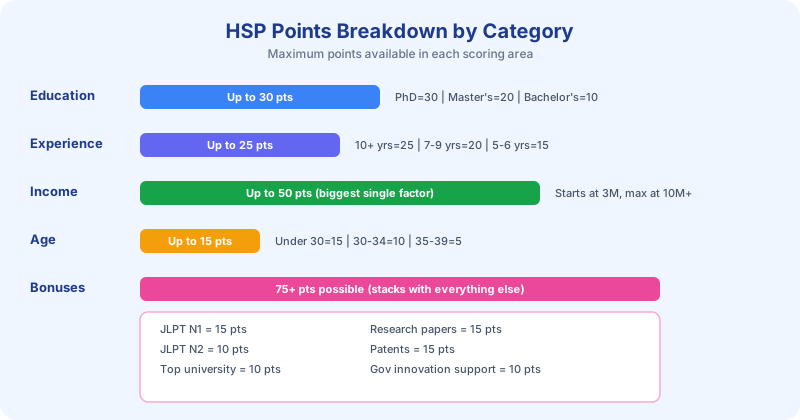
The HSP system scores you across five main dimensions. You need 70 points for HSP status, or 80 points for the fast-track to permanent residency in just one year. Let's break each one down.
Education: Up to 30 Points
Your highest completed degree determines your base education score:
| Degree | Points |
|---|---|
| PhD (博士) | 30 pts |
| Master's (修士) or Professional degree | 20 pts |
| Bachelor's (学士) | 10 pts |
A few things worth noting:
- Dual degrees count. If you have both a Master's and an MBA, you get a 5-point bonus on top of the Master's 20 points.
- The degree must be from an accredited institution. Japan's immigration office does verify this.
- No degree? Not disqualified. You can still reach 70 points through other categories — it's just harder. Income and bonus factors become your best friends.
For Category 1 (Academic Research), a PhD is essentially the baseline expectation. For Category 2 (Technical/Specialist), a Master's is the sweet spot — it gives you 20 points and leaves you only 50 away from the threshold.
Work Experience: Up to 25 Points
This counts professional experience relevant to your field. The scoring is straightforward:
| Years of Experience | Points |
|---|---|
| 10+ years | 25 pts (Cat. 1) / 20 pts (Cat. 2 & 3) |
| 7-9 years | 20 pts (Cat. 1) / 15 pts (Cat. 2 & 3) |
| 5-6 years | 15 pts (Cat. 1) / 10 pts (Cat. 2 & 3) |
| 3-4 years | 10 pts (Cat. 1) / 5 pts (Cat. 2 & 3) |
Important details:
- Category 1 values experience more generously than Categories 2 and 3. The same 7 years gives you 20 points in Cat. 1 but only 15 in Cat. 2.
- Internships and part-time work generally don't count. Immigration is looking for full-time, professional-level experience.
- Experience doesn't have to be in Japan. Your global career history applies. Five years at Google in the US counts the same as five years at a company in Tokyo.
- It must be in a related field. Working as a barista for 3 years doesn't count toward your engineering experience.
Annual Income: Up to 50 Points (The Big One)
Income is the single largest scoring category, and it's also the most nuanced because the thresholds change based on your age. Why? Japan's immigration system acknowledges that a 28-year-old earning ¥5M is relatively more accomplished than a 45-year-old earning the same.
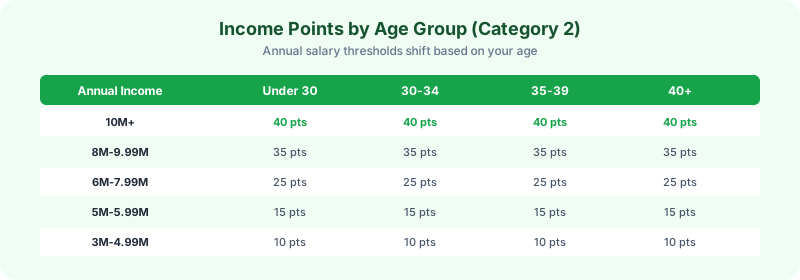
Here's the full breakdown for Category 2 (the most common):
| Annual Income | Under 30 | 30-34 | 35-39 | 40+ |
|---|---|---|---|---|
| ¥10M+ | 40 pts | 40 pts | 40 pts | 40 pts |
| ¥9M-9.99M | 35 pts | 35 pts | 35 pts | 35 pts |
| ¥8M-8.99M | 30 pts | 30 pts | 30 pts | 30 pts |
| ¥7M-7.99M | 25 pts | 25 pts | 25 pts | — |
| ¥6M-6.99M | 25 pts | 25 pts | 20 pts | — |
| ¥5M-5.99M | 15 pts | 15 pts | 15 pts | — |
| ¥4M-4.99M | 10 pts | 10 pts | — | — |
| ¥3M-3.99M | 10 pts | — | — | — |
Key things to understand about the income calculation:
- It's your annual gross salary in Japan, including bonuses and allowances. Stock options and overseas income typically don't count.
- The ¥3M minimum floor is strict. If you earn below ¥3M annually, you get zero income points regardless of other factors.
- Age really matters here. A 28-year-old earning ¥4M gets 10 points, but a 36-year-old at the same salary gets nothing from income.
- Salary has been rising in Japan's tech sector. In 2024-2025, senior engineer offers at major Japanese tech firms regularly exceeded ¥10M, and companies like Mercari, SmartNews, and LINE have pushed compensation even higher to compete for global talent.
Age: Up to 15 Points
Younger applicants get more age points — the logic being that younger professionals have more potential years to contribute to Japan's economy:
| Age | Points |
|---|---|
| Under 30 | 15 pts |
| 30-34 | 10 pts |
| 35-39 | 5 pts |
| 40+ | 0 pts |
This is one area where you can't really "optimize." But it does create urgency: if you're 29 and considering HSP, applying before your 30th birthday saves you 5 points you'd have to make up elsewhere.
Worth noting: while older applicants lose out on age points, they typically compensate with higher income and more work experience. The system is designed so that strong professionals can qualify at any age.
Bonus Points: The Secret Weapon (75+ Points Available)
This is where most people leave points on the table. The bonus category is huge — there are over 75 potential points spread across multiple sub-categories that stack on top of everything else.
Japanese Language Ability
| Certification | Points |
|---|---|
| JLPT N1 or BJT 480+ | 15 pts |
| JLPT N2 or BJT 400+ | 10 pts |
This is often the single easiest way to boost your score. If you're sitting at 60-65 points, getting JLPT N2 (which is achievable with 1-2 years of dedicated study) immediately pushes you past the threshold.
Even if your spoken Japanese isn't perfect, the JLPT is a written test. Many engineers who work in English-speaking environments at their companies have passed N2 through focused study.
Research and Innovation
| Achievement | Points |
|---|---|
| 3+ published research papers | 15 pts |
| 1+ patents (as inventor) | 15 pts |
For Category 1 applicants, this is gold. But even Category 2 applicants can claim these — if you've co-authored academic papers or hold patents from a previous role, these count.
University Ranking
| Qualification | Points |
|---|---|
| Graduated from a top-ranked university | 10 pts |
Japan uses several ranking lists to determine "top" universities:
- Universities listed in at least 2 of the 3 major global rankings (QS, THE, SJTU) in the top 300
- Universities designated by Japan's MEXT (Ministry of Education) partner programs
- Universities in the "Innovative Asia" and similar government programs
If you graduated from any well-known global university (MIT, Stanford, Tsinghua, IITs, NUS, University of Tokyo, etc.), you almost certainly qualify.
Other Bonus Categories
- Company receives government innovation support — 10 pts (your employer needs to be part of specific government-backed innovation programs)
- Completed training by JICA or similar organizations — 5 pts
- Company is a small/medium enterprise (SME) — certain bonus points apply for promoting SME employment
- Graduated from a Japanese university — 10 pts (reflects Japan's preference for people educated in its own system)
- Dual degree holder — 5 pts (having two different types of graduate degrees)
Putting It All Together: Sample Calculations
Profile A — The Senior Engineer:
- Age 31, Master's degree (from a top-300 university), 6 years experience, earning ¥9M, JLPT N2
- Education: 20 + Age: 10 + Experience: 10 + Income: 35 + University bonus: 10 + JLPT N2: 10 = 95 points
- Result: HSP status + PR eligible in 1 year
Profile B — The Mid-Career Researcher:
- Age 37, PhD, 8 years experience, earning ¥6M, 5 published papers, no JLPT
- Education: 30 + Age: 5 + Experience: 20 + Income: 20 + Papers: 15 = 90 points
- Result: HSP status + PR eligible in 1 year
Profile C — The Young Professional:
- Age 27, Bachelor's degree, 3 years experience, earning ¥5M, JLPT N1
- Education: 10 + Age: 15 + Experience: 5 + Income: 15 + JLPT N1: 15 = 60 points
- Result: 10 points short — could bridge the gap with a professional certification or by attending a Japanese university program
Common Mistakes in Points Calculation
- Counting stock options as income. Immigration looks at your actual taxable salary in Japan, not equity compensation.
- Using the wrong experience category. Your experience must match the HSP category you're applying under.
- Forgetting to claim university ranking points. Many applicants don't realize their alma mater qualifies.
- Not checking all three categories. The same person can score differently under Category 1, 2, and 3. Always compare.
- Miscounting years of experience. Part-time and unrelated work doesn't count.
Ready to Calculate Your Score?
Now that you understand exactly how every point is allocated, plug your background into our free evaluation tool. It calculates your score across all three HSP categories and shows you exactly which bonus points you might be missing.
Many people discover they're closer to 70 — or even 80 — than they expected.