The 3 HSP Visa Categories: Which One Gets You to Japan?
In 2023, Japan granted over 30,000 Highly Skilled Professional (HSP) designations — and the number keeps climbing. But here's something many applicants don't realize until they're already filling out forms: the HSP visa isn't one single category. It's actually three different categories, each with its own scoring emphasis and target audience.
Picking the wrong one can mean leaving easy points on the table. Let's break down how each category works so you can maximize your score.
The Three Paths at a Glance
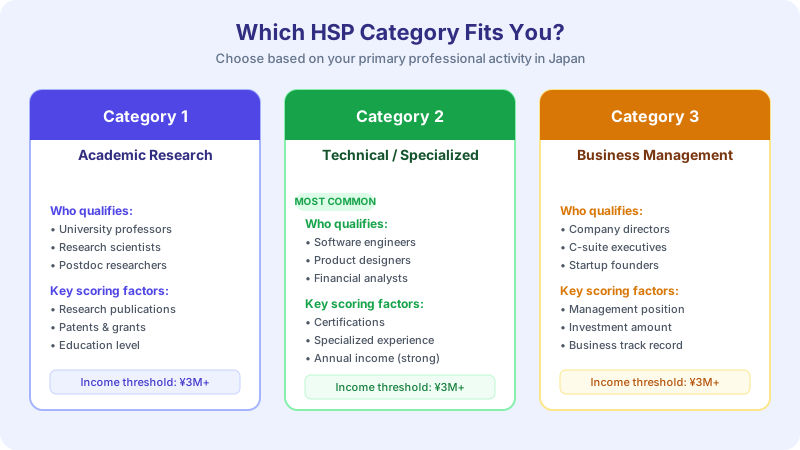
All three categories use the same core scoring dimensions — education, work experience, age, salary, and bonus factors. But the weight of each factor shifts depending on your category. That's why the same person can score very differently under Category 1 vs. Category 2.
Category 1: Academic Research
In a nutshell: You teach, research, or guide graduate students at a university or research institution.
This is the category for people whose work centers around advancing knowledge. If your days involve publishing papers, supervising labs, applying for research grants, or lecturing to students — this is you.
Who qualifies:
- University professors, associate professors, lecturers
- Research scientists at national labs, RIKEN, AIST, or private R&D centers
- Postdoctoral researchers on fixed-term contracts
Where Category 1 shines:
- Research output matters a lot. Published papers, patents, and competitive grants all carry real point value here. If you have 3+ published papers, that's an immediate bonus.
- Education is weighted heavily. A PhD is essentially expected in this category — and it gives you 30 points right away.
- Income thresholds are lower. The salary floor starts at ¥3M, reflecting the reality that academic salaries in Japan aren't always sky-high.
Real example: Dr. Tanaka, a 35-year-old postdoc with a PhD from a top-300 university, 4 published papers, 3 years of research experience, and earning ¥5M annually. She scores about 75 points — enough for HSP status and permanent residency in 3 years.
Category 2: Specialized / Technical Activities
In a nutshell: You're a skilled professional working at a company in Japan — engineer, designer, analyst, consultant, or similar.
This is by far the most common HSP category. If you're employed by a Japanese company (or the Japan office of a global company) in a technical or specialized role, this is almost certainly your path.
Who qualifies:
- Software engineers, data scientists, ML engineers
- Mechanical, electrical, and civil engineers
- Product designers, UX researchers, architects
- Financial analysts, management consultants, marketing strategists
Where Category 2 shines:
- Salary is the biggest lever. Annual income can contribute up to 50 points, and tech salaries in Japan have been rising fast. In 2024, the average offer for senior engineers at major tech companies crossed ¥10M.
- Professional certifications count. Holding qualifications like a Registered Information Technology Professional (情報処理技術者) or similar can add bonus points.
- Work experience adds up quickly. 7+ years in your field gets you 15 points; 10+ years gets the maximum 20.
Real example: Kenji, a 29-year-old software engineer with a Master's degree, 4 years of experience, earning ¥9M at a Tokyo tech company, with JLPT N2. His score: roughly 80 points — qualifying him for permanent residency in just 1 year.
Category 3: Business Management
In a nutshell: You run, direct, or manage a business operating in Japan.
This category is for executives and entrepreneurs. If you're making strategic decisions, sitting on the board, or building a company from scratch in Japan — this is your lane.
Who qualifies:
- Company directors (取締役) and representative directors (代表取締役)
- C-suite executives — CEO, CTO, CFO, COO
- Startup founders who have registered a business in Japan
- Country managers running Japan operations for multinational companies
Where Category 3 shines:
- Management position level matters. Being a representative director (代表取締役) carries more weight than a regular board member.
- Investment amounts contribute. If you've invested ¥10M+ into a Japanese business, that's bonus points.
- Income expectations are higher. Executives generally earn more, so the salary scoring tiers are calibrated for higher brackets. Earning ¥15M+ puts you in a very strong position.
Real example: Maria, a 38-year-old CTO at a Japan-based fintech startup, MBA holder, 10+ years of management experience, earning ¥14M. She scores around 75 points under Category 3.
The Biggest Mistake: Choosing the Wrong Category
Here's a scenario that happens more often than you'd think. An engineer who also manages a small team applies under Category 3 (Business Management) because they "manage" people. Bad move. They'd almost certainly score higher under Category 2, where their technical qualifications and certifications contribute bonus points that don't exist in Category 3.
The rule of thumb: Apply under the category that matches your primary contracted activity, not your job title. And always calculate your score under multiple categories before deciding.
You can only apply under one category. So pick wisely:
| Your primary activity in Japan | Best category |
|---|---|
| Teaching, researching, or advising at a university/lab | Category 1 |
| Working as a technical professional at a company | Category 2 |
| Running, directing, or owning a business | Category 3 |
New in 2023: J-Skip Bypasses Categories Entirely
Worth noting: Japan introduced the J-Skip visa in April 2023, which lets you bypass the points system altogether if you meet certain criteria:
- Annual income ¥20M+ with a Master's degree or higher → Direct HSP status
- Annual income ¥20M+ with 10+ years of work experience → Direct HSP status
J-Skip holders get the same benefits as HSP visa holders (including the 1-year PR fast track). But for the vast majority of professionals, the standard points-based categories remain the main pathway.
Ready to Find Your Score?
Not sure which category gives you the best score? Our free evaluation tool lets you calculate your points across all three categories in minutes. Many people are surprised to find they score higher in a different category than they expected.
Plug in your background and see exactly where you stand.