Fast-Track Permanent Residency Through HSP: The 1-Year and 3-Year Paths
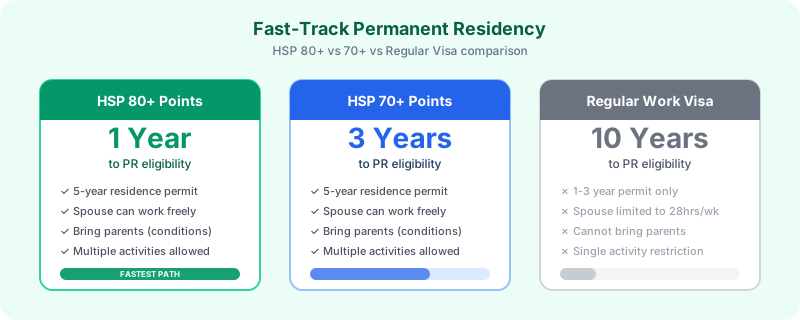
Permanent residency is usually the endgame. It's the reason most people pursue HSP status in the first place — not for the visa category itself, but for the dramatically shortened path to PR that comes with it. Under normal circumstances, you'd need 10 years of continuous residence in Japan to apply for permanent residency. With HSP, that drops to 3 years. With 80+ points, it drops to just 1 year.
That's not a typo. One year. If you arrive in Japan with 80+ HSP points, you can apply for permanent residency 12 months later. This is, by a wide margin, the fastest PR pathway available to work visa holders in Japan.
How the Fast Track Works
The HSP fast track to PR was introduced in 2017 as an amendment to Japan's immigration policy. The logic is straightforward: Japan wants to retain highly skilled professionals, and offering a rapid path to permanent residency is a powerful incentive.
Here's how the three paths compare:
| Path | Points Required | Qualifying Period | Key Advantage |
|---|---|---|---|
| HSP 80+ Fast Track | 80+ points | 1 year | Fastest possible PR |
| HSP 70+ Standard | 70-79 points | 3 years | Still 7 years faster than normal |
| Regular Work Visa | N/A | 10 years | No points requirement |
The qualifying period starts from the date you were recognized as a Highly Skilled Professional — either when your HSP visa was granted, or the date immigration retroactively recognizes your HSP-level points (more on this below).
The Retroactive Recognition Option
Here's something many people don't realize: you don't necessarily need to have held an HSP visa for the entire qualifying period. If you were on a regular work visa (like Engineer/Specialist in Humanities) but can demonstrate that you had 70+ or 80+ points during that time, immigration can retroactively recognize that period.
This means if you've been in Japan for 3 years on a regular work visa, and you can prove you had 70+ points throughout those 3 years, you may be eligible to apply for PR immediately after switching to HSP status — or even apply for PR directly by demonstrating your HSP-level points.
The catch: you need documentation proving your points for the entire period. Tax certificates, employment contracts, degree certificates — everything that supports your claimed points must be valid for the full qualifying period.
What PR Actually Gives You
Permanent residency in Japan is genuinely valuable. Here's what changes when you get it:
No More Visa Renewals
This is the obvious one. No more trips to immigration every 1, 3, or 5 years. No more worrying about whether your renewal will be approved. No more being tied to a specific employer or job category. Your right to live in Japan becomes permanent (with some conditions — see below).
Unrestricted Employment
With PR, you can work in any job, any industry, any role. You're not limited to activities that match your visa category. Want to switch from engineering to running a restaurant? Go ahead. Want to freelance, consult, and do contract work across multiple fields? No restrictions.
Simplified Procedures for Family
Your spouse gets access to a "Spouse of Permanent Resident" visa, which is more flexible than being tied to your specific work visa category. It's also easier to bring other family members to Japan when you hold PR.
Property and Financial Access
While foreigners can technically buy property in Japan on any visa, having PR makes mortgage applications dramatically easier. Most banks prefer — and some require — PR status for foreign nationals applying for home loans. You'll also get better terms on other financial products.
A Safety Net
If you lose your job on a work visa, the clock starts ticking. You need to find new qualifying employment or leave Japan. With PR, losing your job is just losing your job — it doesn't threaten your right to live in the country.
Requirements During the Qualifying Period
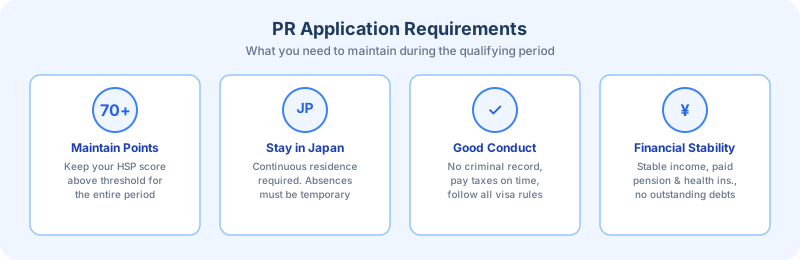
Getting HSP points is step one. Maintaining eligibility throughout the qualifying period is step two, and it's where some people trip up.
Maintain Your Points
Your HSP score must remain at or above the threshold (70 or 80 points) for the entire qualifying period. If your points drop below the threshold at any point — due to aging past a threshold, a salary decrease, or any other factor — your qualifying period effectively resets.
This is why understanding age thresholds matters so much. If you turn 30, 35, or 40 during your qualifying period and lose age points, you need to make sure your total still stays above the threshold. Plan for this in advance.
Continuous Residence in Japan
You need to actually live in Japan during the qualifying period. Short business trips and vacations are fine, but extended absences can be problematic. The general guideline:
- Trips under 3 months: Usually no issue
- Trips 3-6 months: May raise questions; have documentation ready
- Trips over 6 months: Could reset your qualifying period
- Cumulative absences: If you're out of Japan for more than about 100 days per year consistently, it can raise flags
There's no hard legal rule published for exactly how much absence is too much, but immigration officials look at whether Japan is genuinely your primary residence. If you're a consultant who spends half the year overseas, this could be a problem.
Good Conduct
This should go without saying, but: no criminal record, no visa violations, no problems with the law. Even traffic violations can be flagged during PR review, though minor ones typically won't derail an application.
More importantly: tax compliance. Immigration cross-checks your tax records. Late payments, underpayments, or gaps in your tax history will cause problems. If you have any tax irregularities, sort them out before applying.
Financial Stability
You need to demonstrate that you can support yourself (and any dependents) independently. This means:
- Stable income — consistent employment or demonstrable business income
- Paid pension contributions — enrollment and payment in the National Pension (kokumin nenkin) or Employee Pension (kosei nenkin) is checked carefully
- Health insurance — enrollment and payment in the National Health Insurance or employer-provided health insurance
- No outstanding debts to the government — unpaid taxes, pension, or health insurance premiums can sink an application
The pension and health insurance requirements trip up a lot of people. If you were on National Pension and missed payments (or didn't enroll when you should have), you'll need to retroactively pay everything before applying.
The PR Application Process
Once your qualifying period is complete, here's what the actual application looks like.
Document Preparation
The PR application requires extensive documentation. Key items include:
- Application form — Available from the ISA website or your local immigration bureau
- Photo (4cm x 3cm)
- Points calculation sheet — The official calculation sheet filled out for both the current date and your qualifying start date
- Passport and residence card
- Certificate of residence (juminhyo) — from your city/ward office
- Tax certificates — Resident tax payment certificates (kazei shomeisho and nozei shomeisho) for the entire qualifying period
- Pension payment records — From the Japan Pension Service (nenkin jimusho)
- Health insurance payment records
- Employment-related documents — Contract, company registration, etc.
- Documents proving your HSP points — Degree certificates, JLPT certificates, patent records, etc.
- Guarantee letter — From a Japanese national or permanent resident who agrees to act as your guarantor
- Reason for application — A written statement explaining why you want PR
Where to Apply
Submit your application at the immigration bureau that has jurisdiction over your place of residence:
- Tokyo Regional Immigration Bureau (Shinagawa)
- Osaka Regional Immigration Bureau
- Nagoya Regional Immigration Bureau
- Fukuoka Regional Immigration Bureau
If you're not near a regional bureau, you can also submit at a district immigration office. Check the ISA website for the nearest office.
Processing Time
PR applications typically take 4-8 months to process. Some take longer, especially if immigration requests additional documents. During this time:
- Your existing visa remains valid
- You can continue working normally
- You may receive requests for additional documents (respond promptly)
- You can travel, but keep trips short and carry your residence card
Success Rates
There's no published success rate for HSP fast-track PR applications, but anecdotally, applications that have complete documentation and clearly meet all requirements have a high approval rate. The most common reasons for delays or rejections are:
- Incomplete documentation (especially pension/tax records)
- Points recalculation showing the applicant fell below the threshold during the qualifying period
- Excessive time spent outside Japan
- Tax or pension payment irregularities
Common Pitfalls
Points Dropping Below Threshold
This happens most often due to age. If you start your qualifying period at age 29 with exactly 80 points and turn 30 during the period, you lose 5 age points and drop to 75. Your 80+ fast-track qualifying period is broken.
Prevention: Calculate your points at every age threshold you'll cross during the qualifying period. If you're at risk, try to build a buffer of extra points before starting.
Pension and Tax Gaps
Maybe you switched jobs and there was a month where you weren't enrolled in pension. Maybe you were on National Pension and forgot to pay for a few months. These gaps show up in your records, and immigration will flag them.
Prevention: Check your pension records at the nearest Japan Pension Service office (or online via Nenkin Net). If there are gaps, make retroactive payments before applying.
Not Starting the Clock
Some people get HSP status but don't realize that the qualifying period starts from a specific date. If you switch to HSP and then wait 2 years before thinking about PR, make sure you know exactly when your qualifying period started and can document your points from that date forward.
Guarantor Issues
You need a guarantor who is a Japanese national or permanent resident. This person doesn't take on financial liability (despite what the word "guarantor" implies), but they do need to provide their personal information and sign a letter. If you don't have someone in mind, start thinking about this early — it's not something you want to scramble for at the last minute.
Timeline: From HSP to PR
Here's what a realistic timeline looks like for the 80+ fast-track path:
| Time | Action |
|---|---|
| Month 0 | Obtain HSP visa (or confirm retroactive HSP-level points) |
| Month 1-11 | Maintain points, residence, employment, and all obligations |
| Month 10-11 | Begin gathering PR documents |
| Month 12 | Submit PR application |
| Month 12-18 | Wait for processing; respond to any document requests |
| Month 16-20 | Typical approval timeframe |
For the 70+ path, the same timeline applies but the qualifying period is 3 years instead of 1.
After You Get PR
Permanent residency is permanent — but it does come with ongoing obligations:
- Re-entry permits: If you leave Japan for more than 1 year without a re-entry permit (or more than 2 years with a special re-entry permit), you lose your PR status. Always get a re-entry permit before extended trips.
- Address registration: You must keep your address registered at your local city/ward office.
- Residence card renewal: Your residence card has an expiration date (usually 7 years). You need to renew the card before it expires, but this is a simple administrative process — your PR status itself doesn't expire.
- Tax obligations: You're still required to pay taxes and maintain pension/health insurance enrollment.
The Bottom Line
The HSP fast track to permanent residency is arguably the single most valuable benefit of the HSP visa system. Going from 10 years to 1 year — or even 3 years — is a transformation in your immigration timeline.
If you're currently below the points threshold, see our guide on improvement strategies for practical ways to close the gap. If you're ready to calculate your score, use the official ISA calculation sheet or check the ISA's HSP overview for the latest guidelines.
The clock starts when you get your points. The sooner you start, the sooner you get PR.